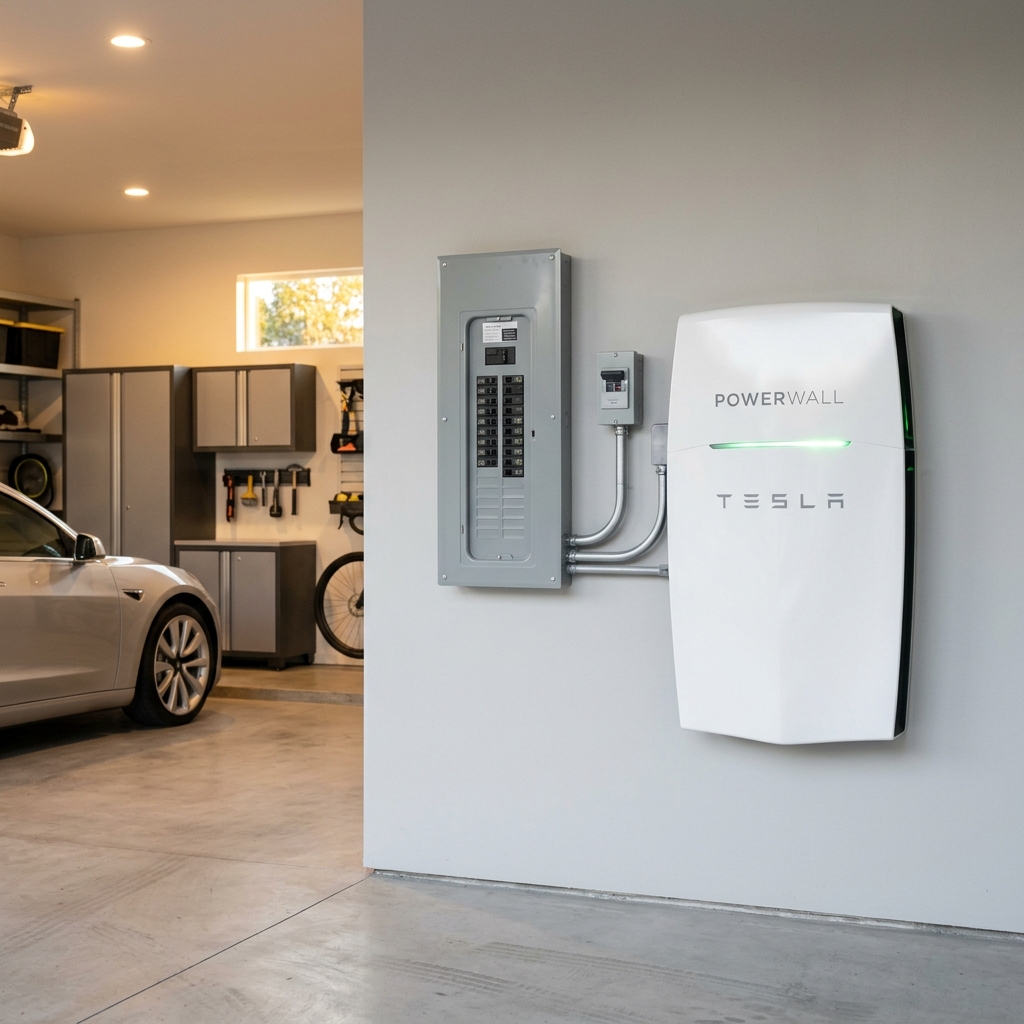
Beyond the Panel: Storing the Sun
Solar panels generate electricity during daylight hours, but what happens when the sun goes down? Historically, homeowners relied on the utility grid to fill the gap. But the rapid advancement of home battery storage is changing the equation entirely.
Battery storage allows homeowners to store excess solar energy produced during the day and use it at night, during peak-rate hours, or during power outages. It's the missing piece that makes solar a truly comprehensive energy solution.
How Home Batteries Work
A home battery system is conceptually straightforward:
- Charging: During the day, your solar panels produce electricity. After powering your home's immediate needs, excess energy charges the battery.
- Storage: The battery stores this energy as chemical energy, ready to be converted back to electricity when needed.
- Discharge: In the evening, at night, or during a power outage, the battery releases its stored energy to power your home.
- Grid Interaction: Smart battery systems can also charge from the grid during low-rate hours and discharge during expensive peak hours, maximizing savings.
Leading Battery Technologies
The home battery market has matured significantly. Here are the leading options:
Tesla Powerwall 3:
- Capacity: 13.5 kWh per unit
- Integrated solar inverter
- Seamless backup during outages
- Smartphone monitoring and control
Enphase IQ Battery:
- Modular design (3.36 kWh per module)
- Scales to your needs
- Pairs perfectly with Enphase microinverters
Franklin WholePower:
- 13.6 kWh capacity
- Manages AC-coupled and DC-coupled systems
- Advanced self-consumption optimization
Generac PWRcell:
- Modular from 9 to 18 kWh
- Integrated with Generac generator ecosystem
- Strong backup power performance
The Financial Case for Batteries
Home batteries add cost to a solar installation, typically between $8,000 and $16,000. However, several factors can make them financially attractive:
- Time-of-Use Rate Arbitrage: Store cheap daytime solar and use it during expensive evening peak rates. In states like California, the difference can exceed $0.30/kWh.
- Demand Charge Reduction: For commercial customers, batteries can shave peak demand charges, which often represent 30% to 50% of utility bills.
- Backup Power Value: Avoiding the costs associated with power outages — spoiled food, lost productivity, hotel stays — adds real economic value.
- Federal Tax Credit: The ITC's 30% credit applies to battery storage systems when paired with solar, significantly reducing the upfront cost.
Resilience and Energy Independence
Beyond economics, batteries provide peace of mind. The frequency and severity of power outages in the United States have increased significantly over the past decade due to extreme weather events, aging grid infrastructure, and increased demand.
A solar-plus-battery system provides:
- Automatic Backup: Seamless transition to battery power during grid outages.
- Extended Outage Protection: Batteries recharge from solar panels each day, providing indefinite backup for essential loads.
- Grid Independence: Reduce reliance on the utility grid and insulate yourself from rate increases and grid instability.
The Future of Energy Storage
Battery technology is advancing rapidly. Costs have dropped by over 80% in the past decade, and new chemistries — including sodium-ion and solid-state batteries — promise further improvements in cost, capacity, and lifespan.
At Solar Soul Energy, we design solar-plus-storage systems that are tailored to each home's unique energy profile. Whether you're looking for backup power, maximum savings, or complete grid independence, we have a solution that fits.
Solar Soul Energy — Your Energy, Your Way.