The Science Behind Solar Energy
Every hour, the sun delivers enough energy to Earth's surface to power human civilization for an entire year. Solar panels are the technology that allows us to capture a portion of that extraordinary resource and convert it into usable electricity.
But how exactly does this process work? Let's break it down step by step.
The Photovoltaic Effect
At the heart of every solar panel is the photovoltaic effect — a phenomenon first discovered by French physicist Edmond Becquerel in 1839. Here's how it works:
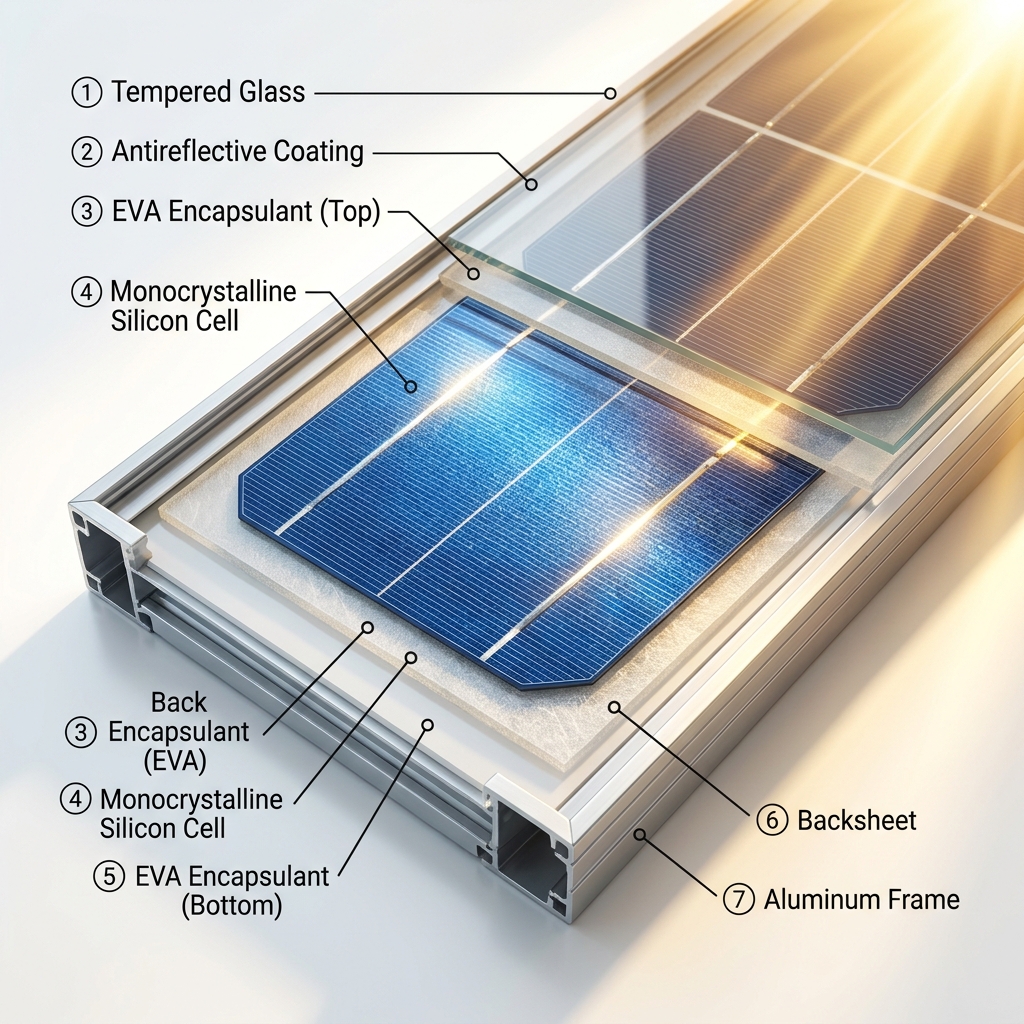
- Sunlight hits the solar cell. Each solar panel contains dozens of photovoltaic cells made primarily of silicon, a semiconductor material.
- Photons knock electrons loose. When photons (particles of light) strike the silicon cell, they transfer their energy to electrons in the material, knocking them free from their atoms.
- Electric field creates flow. Each cell is manufactured with a positive layer and a negative layer, creating an electric field. This field pushes the freed electrons in a specific direction, creating an electrical current.
- Current is captured. Metal contacts on the top and bottom of each cell collect the flowing electrons and channel them into wires as direct current (DC) electricity.
From DC to AC: The Role of the Inverter
Your home appliances run on alternating current (AC), but solar panels produce direct current (DC). This is where the inverter comes in — one of the most critical components of a solar energy system.
The inverter converts DC electricity from the panels into AC electricity that your home can use. Modern inverters also optimize energy production, monitor system performance, and provide data you can view from your smartphone.
There are three main types of inverters:
- String Inverters: The most common and affordable option. All panels are connected in a series ("string"), and a single inverter handles the conversion.
- Microinverters: Small inverters attached to each individual panel. More expensive but offer better performance, especially in partially shaded conditions.
- Power Optimizers: A hybrid approach that pairs panel-level optimizers with a central string inverter.
Net Metering: Getting Credit for Excess Energy
On sunny days, your solar panels may produce more electricity than your home needs. With net metering, that excess energy flows back to the utility grid, and you receive credits on your electricity bill.
At night or on cloudy days, when your panels produce less energy, you draw power from the grid and use those credits. This means your solar system effectively "banks" energy with the utility company.
Net metering policies vary by state, but they significantly improve the financial return on a solar investment.
What Affects Panel Performance?
Several factors influence how much electricity your solar panels produce:
- Sun Exposure: More direct sunlight means more energy. South-facing roofs in the Northern Hemisphere receive the most sun.
- Temperature: Surprisingly, solar panels perform slightly better in cooler temperatures. Extreme heat can reduce efficiency by 10% to 25%.
- Shading: Even partial shading on one panel can reduce the output of an entire string. Proper system design minimizes this issue.
- Panel Quality: Higher-efficiency panels convert more sunlight into electricity. Premium panels typically achieve 20% to 22% efficiency.
How Long Do Solar Panels Last?
Modern solar panels are built to last. Most manufacturers offer 25-year performance warranties, guaranteeing that panels will still produce at least 80% of their original output after a quarter century.
In practice, many panels continue to function effectively for 30 to 40 years. And because solar panels have no moving parts, maintenance is minimal — typically just occasional cleaning.
Making the Decision
Understanding how solar panels work helps you evaluate proposals from solar installers, compare equipment options, and feel confident in your investment. At Solar Soul Energy, we believe that informed homeowners make the best decisions.
Solar Soul Energy — Knowledge Powers Better Decisions.